Showing posts with label taking care of the earth and ourselves. Show all posts

Sunday, June 24, 2007

C25K Update and a Party!

First of all: last weekend's 5k. The course was advertised as easy, but it turned out to be up the side of a mountain! (I'm not joking--my running shoes were sliding on the steep inclines.) I made it halfway before I--while very upset--gave up. But my mother, husband, and hard-core-runner sister-in-law all told me that running half of that course was an awesome accomplishment. Still, I'm ready to finish a 5k now. That will be this coming week!

I have a-whole-nother post to write about my life and stress and food and exercise lately. But before that . . .

Last night, my husband and I hosted a “Summer Harvest” party. Each guest was asked to bring a dish or drink that featured locally produced foods. I had asked Dan to take photos, but he was too busy helping me host. We all had a great time, though, eating dinner–slowly working our way through appetizers, then soup, then drinks, then the main course, then dessert–and playing a couple of rounds of Apples to Apples, a very fun party game when people get into it.

Here were our locally inspired items:

Sweetwater Road Trip (Atlanta microbrewery beer)

Mojitos with AL cane syrup (in lieu of simple syrup) and local organic mint leaves

Bruschetta with local organic tomatoes and herbs from our kitchen (windowsill) garden with French bread and Bulger Creek chevre

Sweet Grass Dairy Green Hill cheese with my mother’s triple-berry jam and whole-wheat crackers

Koinonia (South GA) cinnamon/sugar pecans

Yellow pepper soup (a pureed soup with yellow peppers, potatoes, and other ingredients I can’t remember–delicious!)–I forgot to ask my friend Becky which of her ingredients were local

Tofu quiche with local organic broccoli, tomatoes, and herbs and crust made from local buckwheat flour

Tomato/cucumber salad with local organic tomatoes and cucumbers (from the Saturday farmers' market in the town where I grew up!)

A zucchini/squash/garlic medley from my friend Melissa’s garden

Cheesecake with a raspberry sauce

And peach cobbler made with Georgia peaches and a local flour mix crust

We certainly did not feel deprived by eating locally derived foods!

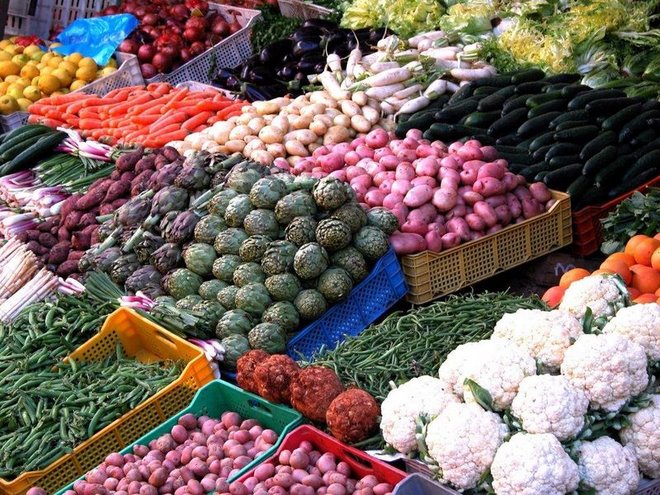
Did you know that food in the US, on average, has traveled over 1500 miles to reach us? That means that the foods we buy in the grocery store have used a lot of gas, created a lot of pollution, and often have required a lot of long-term refrigeration to reach us. Locally produced vegetables and fruits are often higher in vitamin content when they reach us, their short trip times are far less polluting, and their freshness makes them taste a lot better!

If you are interested in finding local food sources near you and you are in the US, I encourage you to visit Local Harvest to check out CSAs (Community Supported Agriculture) and farmers’ markets in your area.

Then you can host the next harvest party. . . .

Saturday, May 12, 2007

Enjoying Food on a Diet

I remember standing in line in Subway soon after the Jared craze. Two of the three women in line in front of me had come in from their office together for lunch. They had run into the third woman, whom they both knew. All were overweight, though not obese by much, if at all; they were about the same size as me. One of the two women who were together was explaining how their lunches worked.

"We eat a 6" on white or wheat every day for lunch--no cheese or mayonnaise or oil. On Fridays we celebrate by adding a bag of baked chips." They proceeded to discuss how many WW points the meals were.

I was in Weight Watchers, too. I was struck by how depressing I found their meal plan. Can that really be what it takes? I wondered. Boring sandwiches on only wheat or white, meat and vegetables and vinegar--nothing else? And a bag of cardboard-tasting chips to celebrate once a week?

I was thinking about those women's conversation this morning as I walked home from my run. The answer is clear in my mind these days. No, that is not what it takes. It might work, but it's not the only way or, in my mind, the best way to do this weight loss thing.

I don't eat sweets incredibly often anymore. If I do, it's usually just 2-3 bites. I've realized that when I eat sweets, I'm usually nearly full from a meal beforehand. And I hate feeling stuffed these days, so I eat enough to get a taste and stop there. But if I go somewhere and get a really incredible dessert--like the banana-hazelnut-chocolate tart I had recently from Chocolate Pink--if I want the whole thing and am not full by the time I eat a couple of bites, I eat the whole thing. (With the pastry from Chocolate Pink, it actually happened to take me two sittings to eat it all.) When I eat it, I feel no guilt or remorse, just genuine pleasure and appreciation.

I used to not understand that concept at all. I thought people who talked about enjoyment in moderation were crazy. If someone lets me have a go at ice cream, I'll eat the whole tub, I thought. My days were filled with the diet substitutions that I thought would provide external controls to keep me from expanding. Baked chips, low-calorie bread, non-fat ice cream, Cool Whip, diet soda--you get the idea. After I had cancer and started researching what I could do to change my chance of getting it again and/or dying from it, I realized I was ingesting a whole lot of really messed-up chemicals. Later, I realized that the artificial ingredients in, and the acidity of, most of those foods made me feel ill with stomach aches and bladder pains anyway.

Then I realized, too, that eating those foods often drew me in to eating twice as many of each kind in my desperate attempt to get some satisfaction from the crap I was ingesting.

Do you not find 1 tablespoon of real whipped cream far more satisfying than a quarter cup of fat-free Cool Whip? I do. (And what is Cool Whip made of, anyway?)

I changed my life.

I don't drink sodas anymore--period. I've had maybe two in two years, and both of those were special kinds (no corn syrup!) on special occasions where I really wanted them. Do you realize how irrational it is for people to drink such sweet drinks as a staple of our diets? It's crazy. I was as 'addicted' as anyone, and I just quit. Feeling ill, feeling like you're on a constant sugar feed, isn't worth it. I cut out almost all corn syrup. I cut out all artificial sweeteners. I started eating only sugar/honey/molasses as sweetener . . . eating sugar in delicious forms like real maple syrup on homemade waffles, petit fors from a local bakery, a small scoop of chocolate-java-chip icream, etc. Not crappy Little Debbie cakes--even the full-fat kind of that dessert is not fulfilling. If I want dessert, I want something incredible. Something I make myself, or something that comes from a store or restaurant that specializes in good desserts.

At first I just went nuts, really. I ate lots of sugar, and I gained weight. But over time, I've gotten my cravings under control, as I've discussed previously, and these days, I eat real food (homemade food) that is good for me 80-90 percent of the time, and the other 10-20 percent of the time, I revel in what I am eating instead of feeling any guilt about it.

Even that 80-90 percent of the time isn't about deprivation, either--I think that's important to note. My healthy meals are about balancing things out--lots of vegetables, some healthy fats, some healthy proteins, some great grains, and always (always always always) wonderful seasonings and sauces. If I eat a higher calorie lunch, I have a lower calorie dinner. Breakfast stays pretty much standard to keep me from accidentally sneaking in calories I don't mean to eat. I try not to let myself get ravenous, which is when I make bad food decisions.

Do I spend more on food than some people do? Yes, absolutely. And I know that I'm 100% worth it. I don't believe in living in debt, so my husband and I make sacrifices elsewhere, but we eat well. What will happen in your life is what you make a priority, and a long, healthy, satisfying life is a huge priority for me.

If I think I want dessert, I remind myself of everywhere in Atlanta (and in my house) I can find all sorts of amazing desserts, and I ask myself if what I have in mind is actually what I want, or whether I am feeling something else emotionally that I'm putting off on food. I craved a cupcake intermittently for two weeks a couple of months ago and finally went and got one. I got a cupcake from the top-rated cupcake spot in Atlanta, and it was perfect. It was incredible and just hit the spot--partly because I knew I could thoroughly enjoy it with the knowledge it was exactly what I wanted.

I'm all for people realizing that we can do this, we can all do this--really, we can. We don't actually need diet gurus to restrict our lives in painful ways. We just need to get back in touch with what it feels like to make healthy foods that also taste good, to eat reasonable portions, to let ourselves enjoy things in moderation. You, too, do have the ability to enjoy things in moderation, just as I do even though I once didn't realize I could.

Of course, we also have to deal with the psychological and biological issues related to cravings, weight gain, etc. I have definitely learned a great deal from reading articles and books that go into the psychology and biology of dieting, eating, etc. Bob Greene's recent Best Life Diet and the book Mindless Eating, along with many O Magazine articles, come to mind first. My husband and I eat off of salad plates for every meal; there are no wide open spaces on our plates that we will feel we need to fill with food. We serve ourselves out of the kitchen instead of off the table, and we don't go back for seconds until we have finished our plates. (Usually, we don't go back for seconds at all. Having a plate that's usually 2/3 of veggies helps keep us full from early on in the meal.) When I see a high-fat food, I know that my body will kick in the desire to eat it because of humans' ingrained biological tendency to think that we must eat high-fat foods whenever we can to fend off the seasons of famine that have been so common throughout human biological history. I can deal with these things much more calmly when I understand what's going on behind the curtains of my mind when I'm faced with food issues.

Additionally, it's been helpful to learn--starting with my anti-cancer research--that there is an imperative for our bodies and for this planet for us to take better care of ourselves and refuse to eat food that has been produced in really awful, wasteful, polluting manners. I had a professor who also owned a cattle farm tell me that I would, like she, no longer eat fast food burgers if I went to a cattle auction and saw the diseased cattle fast food restaurants chose to use for their meat. Reading Fast Food Nation was a great nudge in that direction for me as well, and I recently finished and highly recommend The Omnivore's Dilemma, which was a very in-depth look at our various eating habits in the US. (Did you know that, indirectly, we eat more corn than Latin American countries that rely on corn for 60-80 percent of their diets? That's crazy!) These books are fascinating, very engaging--not dry at all--and they take you behind the scenes of America's food production to make you think about what you really should and should not be supporting with your consumption.

I was thinking about those women at Subway because I was thinking about WW no-point soup versus the soup I made a couple of nights ago. That's a different post for later, though.

Tuesday, May 8, 2007

Vegetarian Stir-Fry

Easy-peasy stir-fries I made in my childhood (a frequent affair) went something like this: Dump frozen chicken/veggie mix into flat non-stick pan. Add some soy sauce and a little bit of oil. Make some boil-in-bag rice. “Stir-fry” (more like boil) until veggies are cooked and soggy. Dump over watery rice and add lots of (sweet-from-corn-syrup) teriyaki sauce. Despite how unappetizing it sounds, I loved those meals.

But my tastes have evolved, and I’m eating local, fresh, organic (grown-without-pesticides if not officially organic) food whenever possible. Last Saturday, I picked up a mix of vegetables that were tucked in a basket and asked the farmer what he intended purchasers to make with it. “Stir-fry,” he said, and then after thinking a moment, “Or soup. Or salad, actually.” I went with stir-fry, and I added a few other local veggies, so that my stir-fry mix was zucchini, yellow (summer) squash, red onion, broccoli, bok choy (first time cooking bok choy!), carrots, radishes, and broccoli. Chopping it all and separating it into the groups I’d add to the stir-fry took a while, and the whole process of making stir-fry from scratch made my kitchen quite messy, but it was worth it. I served it over red quinoa, an heirloom variety of this high-protein, nutty grain that has been eaten in South America for thousands of years.

It was a great lunch to make today when I had plenty of time to chop. Here’s how I pulled it all together.

Tasty Vegetarian Stir-Fry (simple but for the chopping)

A mix of vegetables

1 block of tofu, preferably frozen, defrosted, and squeezed or pressed for 20 minutes under something heavy (or tempeh)

Several tablespoons of soy sauce or Bragg’s Amino Acids

1 piece of fresh ginger, preferably frozen (Freezing it makes it easier to deal with)

1 tsp. or so of molasses

2 cloves of garlic (more or less, depending on your love of garlic)

some grain for cooking (brown rice? quinoa?) and whatever it needs with it to cook (I often cook mine in veggie broth)

1-3 T of sesame oil (or canola oil in a pinch), depending on how much stir-fry you’re making

Tasty additions or changes, such as adding toasted sesame seeds at the end . . . or exchanging honey for the molasses–whatever you feel inspired to do!

Stir-fry is a meal it is important to prepare your kitchen to make. The French term for this is mis en place–everything in its place. What that means is you go ahead and chop your veggies, pull out your spices, mix your pre-made sauce, etc., before you ever start cooking. In stir-fry, your meal comes together very quickly on the stove, and if you are chopping another vegetable or searching for your ginger while your first veggies are cooking, you’re going to end up with a soggy or burnt meal–not what you are going for. Many chefs use mis en place regularly to make meals cook more smoothly. It does make for more dirty dishes many times, but it also makes for better end results.

Back to the recipe:

Chop your vegetables and protein into fairly uniform, bite-size pieces, and separate them into bunches based loosely on how quickly they will cook. I had onion, radishes and carrots in a bowl; chopped, pressed tofu in a bowl; broccoli and bok choy in a bowl; and zucchini and squash in a bowl–to go into my stir fry in that order.

Peel and grate a 1/2" piece of ginger (or more, if you love ginger.) Mix the soy sauce, ginger, molasses, and garlic in a small bowl or ramekin. (You could also stir-fry the ginger and/or garlic in the stir-fry with the first veggies instead.)

Start the grain of choice cooking. (Of course, if your grain takes 50 minutes to cook and can sit once it’s done, you can start it while you are still chopping your veggies or even beforehand. Mine only took 15 min. to cook, though.)

Put on an apron if you want to avoid getting splattered.

Heat a tall pan–preferably a wok or other slope-sided pan–on medium-high heat. Add your longest-cooking veggies; stir regularly for about 2 minutes. Add your protein and your next veggies. Keep stirring and tossing the veggies. Continue until you have added all your veggies, with 1-2 minute intervals between additions. Add a bit more oil if your veggies start sticking to the bottom.

As soon as you have added your last vegetables, pour in your sauce, and stir well. Cover, and steam for 1-2 minutes. Stir your vegetables again. They may be done at this point; if not, keep stirring for a couple more minutes.

Serve over your grain.

I like this simple sauce in the stir-fry because it lets the vegetables’ flavor shine through while still adding something to them.

Mmmmm deeeeeelicious!*

stirfry.jpg

*Dan recommends serving this meal to any spouse who has had surgery that morning to provide super fortification against any bad things happening post-surgery. The fresh, local veggies provide lots of vitamins, and the tofu, Bragg’s, and quinoa all provide protein.

Monday, March 12, 2007

Local or organic? Why not both?

Time Magazine’s cover story this past week was Forget Organic–Eat Local. The title is a bit of a misnomer for what the article contains; I didn’t want to buy the magazine but was interested to read the article online. It’s really the story of one man considering the dilemma of whether organic trumps local or vice versa for his habits and desires. In the end, locally grown food that was grown without pesticides (whether certified organic or not) wins. But that doesn’t surprise you, does it? It certainly doesn’t surprise me.

One amusing moment in the article is the author wondering whether people actually could survive on what, say, the Northeastern US could produce through the winter. Um, yeah. How do you think your ancestors survived for you to exist? They weren’t shipping apples from New Zealand to your forebearers in the 1800’s. Perhaps our palates now would find entirely local eating (or nearly entirely local eating, as spices and specialty foods have long been shipped at intervals) boring, but of course it can be done.

My husband and I have spent the last year learning to eat mostly locally grown foods that do not rely on artificial pesticides, and learning what the Southeastern US grows has been fascinating. The food is of amazingly high quality since it reaches us mostly within 24 hours of picking. I will be sad when our CSA stops giving us the absolutely delicious butter lettuce that apparently thrives in GA in winter. But I am also looking forward to what spring brings us in our produce. I’ve always loved the changing of seasons, and it’s very homey to have our diet shift (to some extent–we do buy some stuff at Whole Foods) based on what the earth is able to produce around us at any given time.

Friday, February 23, 2007

Meal Planning: An essential for my success in healthy eating

Many times when I'm flipping through dieters' blogs, I see statements like, "I am hungry and don't know what to eat tonight." Or "I don't have anything at home to eat, so I'm tempted to go out." I used to live that way as well; I tried to keep some staples in the house, but meals were largely whatever I could rustle up and combine.

That changed when I developed medical problems related to food (IC); suddenly, figuring out what to eat if I hadn't planned my meals was a very upsetting prospect, as I was often left with little to eat that wouldn't make me ill. Going out to eat regularly was expensive and still often left me sick. I learned that I had to plan my meals--preferably for each week on the weekends, so that I had time to decide what we wanted and didn't have stuff go bad in the fridge from waiting too long for me to use it.

Even as my medical problems have faded (if you have a bad case of IC, we should talk--my doctor is a miracle worker), I have stuck to planning our meals week by week. I find that planning our meals is important financially to keep us from eating out too often, and it's also important to enable me to balance meals that are higher in calories/fat/sugar with ones that are lower in them. I try to make sure every meal is very high in nutrients from vegetable and fruit content. I almost always pick whole grains, and I put a good source of protein in virtually every meal.

Right now, I am usually planning our meals Wednesday to Tuesday so that I have time to figure out each week what we'll be getting from our CSA's Wednesday deliveries. This week we were very busy, so I'm planning today. (I have today off from work.) While I'm planning, I use Google and allrecipes.com to search for recipes that have the ingredients that I either know I want to use or know I'll have on hand because of the CSA. I also flip through cookbooks, any magazines we have with food, and my fat three-ring binder where I keep copies of recipes I like, divided by season, stored in plastic page covers. For the most part (though this week isn't as good about this as previous ones), I try to keep most of our meals seasonally appropriate.

When I am figuring out what we will eat, I first label my Word page with the days of the week and any days we have things going on that might affect meals. If I know I want to eat out on any particular night (we go out about once a week), I label that night on my sheet. Otherwise, I may leave one night blank so that we can shift the meals around and eat out once that week. (I didn't do that this week because we've eaten out so often lately.)

Then I plan out our meals. Our weeknight meals are usually simple; I try to keep my hands-on time for those meals to 30 minutes or less, though sometimes with baking they may take as long as an hour (or more, on rare occasions). As I choose a meal for a day, I label that day with the meal on my Word doc. If we have weekends like this one where I will not be very busy, I sometimes enjoy making more elaborate meals--like my Saturday night Indian feast this week. As I am planning, I keep up the pages with recipes that I am looking at. Then I print the recipes, make notes on them about any changes I want to make, and, starting from the first day listed on the my Word Doc, I go down the page and type in what ingredients I need to purchase at the store and what recipe those ingredients correspond to. (If the grocery store doesn't have an important ingredient, I want to know what else not to buy to cancel out that recipe.) After I have finished adding ingredients from recipes, I add to the list any items we need to pick up for our regular consumption--almond milk for my husband's breakfasts, for example. I put question marks beside any items that we may already have in the house--I check for those items right before I leave for the store.

As I am typing up my list of ingredients, I separate the list into the parts of the grocery store I vist, in the order I reach them while walking through the store: produce, bulk and nuts, canned/boxed foods, frozen foods, general dairy, refrigerated protein, beer/wine, the cheese counter, most desserts, and then miscellaneous items. (I know that I buy organic and fair-trade whenever possible, so I do not note that on my list unless I'm sending my husband to the store without me!) My process might sound anal retentive to some, but it makes my time in the store more efficient when I'm not wandering back and forth for this ingredient and that one. I cross off each ingredient on my list as I go so that I accidentally do not forget to buy something I need. If I am going to get an ingredient from another store or source, I put a box around that word.

One bonus of shopping with a week's meal plan is that while I might add an item or two while I'm in the store, I keep myself from buying all sorts of impulse purchases when I know that I have a list of foods that will keep us from being hungry over the next few days.

I'm sharing all of this information in such great detail because I find that planning my meals like this keeps me on track. I think it might be important for other people who are watching their food choices (and/or their budget!) as well.

To give you an example of what my final product looks like, this is my meal plan for the week:

Friday--Vegetarian shepherd's pie (Vegetarian Times, p. 11) with a side salad with avocado, Parmesan, and a light dijon dressing
Saturday--(lunch) oatmeal with apples, egg cups; (dinner) dhal with sides of roasted tomatoes, toasted pita bread, raita, and green onion/veggie fritters
Sunday--(lunch) pitas with hummus, raita, cucumber, spinach, onion, and tomatoes and sweet potato fries; (dinner) Spicy Coconut Sweet Potato Soup with Collard Greens with crispy tempeh strips (Fresh Food Fast, p. 230)
Monday--big salad with roasted winter rosemary vegetables (onion, turnip, rutabaga, sweet potato) and pan-fried goat cheese (MAKE DRESSING), refrigerated WF soup
Tuesday (I have AOM)--chickpea salad with lemon and Parmesan; Greek pasta salad with carrots, tomatoes, and cucumber; cold broccoli with garlic--for us to take with us to work (MAKE ON MON)
Wednesday (D. teaches class, I have PL)--leftovers

7 apples (oatmeal and breakfast)
2 pears (snacks)
1 c. cilantro (dhal, soup)
2 lb. tomatoes + 1 (roasting and sandwiches)
1 English cucumber (raita)
1 regular cucumber (pasta salad)
fresh mint (raita)
1 zucchini (fritters)
6 carrots (2 for fritters, 2 for roasted veggies, 2 for pasta salad)
4 yellow onion (shepherd's pie = 1, sandwich + salad = 1, soup = 2)
2 sweet potatoes (shepherd's pie on Friday, before farmer's market)
2 regular potatoes
4 sweet potatoes (sweet potato fries = 2, roasted veggie salad = 1, soup = 1) (F. MARKET)
1 rutabaga (salad)
1 turnip (salad) (F. MARKET)
1 Meyer lemon (salad dressing)
1 lemon (chickpeas)
broccoli (cold broccoli with garlic)
garlic
fresh dill (tzatziki)
1 small jalapeno--subsitute poblano? (soup)
1 small bunch of collard greens (soup)
1 lime (soup)
2 shallots (shepherd's pie)

brown jasmine rice (soup)
1 c. red lentils (dhal)

spiral whole-wheat pasta (pasta salad)
coriander? (soup)
canola oil
vegetarian gravy mix (shepherd's pie)
dijon mustard (salad)

frozen peas and carrots mix

1 c. of Greek yogurt (1/2 c. for raita, 1/2 c. for tzatziki)
goat cheese (salad)
small container milk (shepherd's pie)

hummus (sandwiches)
1 container of ground tofu (shepherd's pie)
2 containers of tempeh strips (soup & tempeh)

pita bread

WF refrigerated soup

Eating organic food cheaply

MSN has an interesting article on eating only organic foods for $7/day.

We spend a lot more than $7/day on food but have found, as the article says, that if you are trying to eat economically and healthfully at a reasonable price, you aren't going to be having a whole lot of meat. Fortunately, one of our goals was to switch to vegetarian eating at home for health reasons, so we have no complaints about doing that.

One of the benefits of buying local organic foods, additionally, is that you can not only get a lower price than you might otherwise--you also get food that has been picked recently and is at the peak of its flavor. It really makes a big difference in the quality of a simple meal.